Designing a therapeutic application to help people fight cellphone addiction.
Master’s Thesis
Experience Design, Design ResearchSeptember 2021 - March 2022
My Responsibilities: Problem space identification, user research, synthesis, prototype development, UX design, branding, project pacing.
Deliverables: App prototype, insights, frameworks, final thesis presentation.
Overview
I completed a 6 month thesis project as the culmination of my master’s degree. This was a solo research and design project where I had free reign to select an area of interest and plan a project which aligned to my own individual goals. I focused on investigating cell phone addiction through the lens of mental health, developing a prototype of an application in Figma – titled Intermission. I presented this work as the final step of receiving my master’s, and received positive feedback recommending I explore bringing Intermission to developers
Intermission is an application which addresses the underlying mental health drivers for cell phone usage, interrupts destructive cycles to form healthy behaviors, and provides users with detailed insights into their phone usage and its relationship with their mental and physical health.
Opportunity
Impacted by my own negative relationship with my phone and social media, I was drawn to the space of cell phone addiction, striving to create something more impactful than the boiler plate screen time restrictions on cell phones.
I started this work by thinking about cell phone addiction as a medical condition and expanding to understand cell phone usage in relation to mental health issues. Ultimately, I found that peoples’ phone usage and mental health were tied together in a destructive cycle where each negatively impacted the other. I identified an opportunity to create personalized, responsive application which integrated and interrupted daily phone usage rhythms when mental health was suffering.
Process

Problem Space IdentificationWith the project starting as a blank slate, I brainstormed various areas of interest, knowing I wanted to focus on something health related that also gave me an opportunity to get significant experience doing the complete end-to-end UX and UI design within Figma.
I chose to focus on cell phone addiction, with the initial prompting question of: What if we thought about cell phone addiction the same as any other addiction like alcohol or drugs?
Primary Research (Interviews and Analogous Research)I started by doing research into different treatments and programs for various addictions and mental disorders, including substance abuse as well as eating disorders. I found a recovery group called Internet & Technology Addicts Anonymous, built on the same principles as Alcoholics Anonymous and attended a few meetings to learn from their methodology.
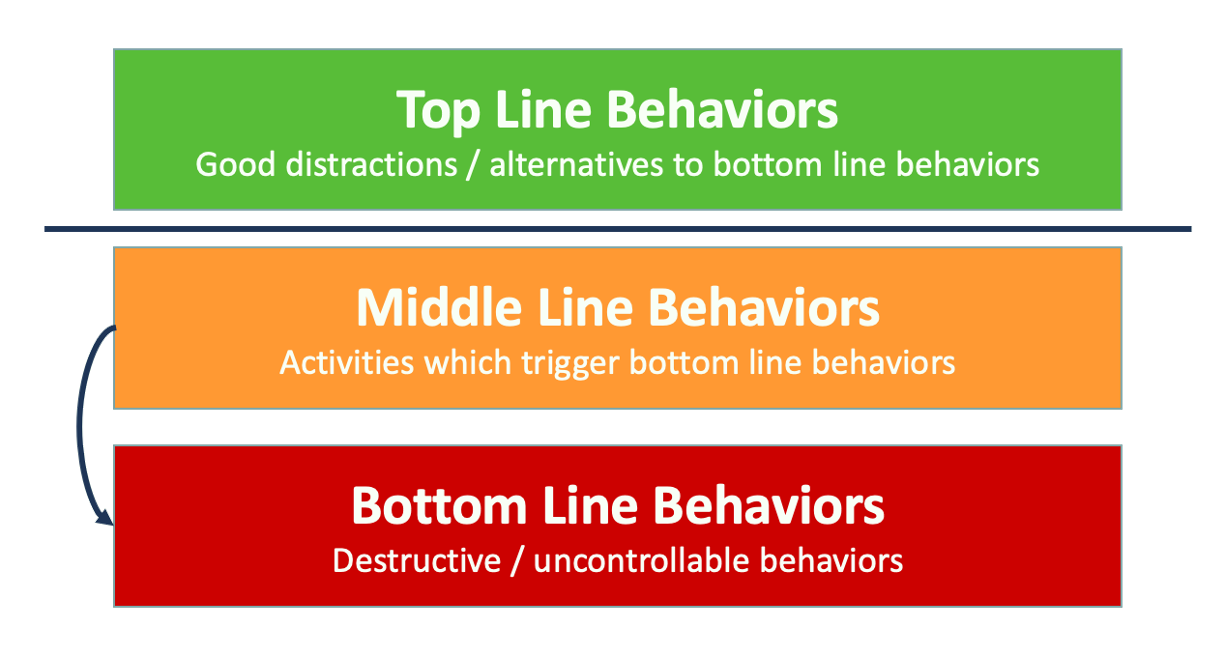
There was framework which directly impacted the rest of my project, focused on the hierarchy of behaviors, shown to the right. This was a worksheet participants were asked to fill out as they started their recovery – identifying the bottom line, or destructive, behaviors they wanted to cut out. After that, identifying what are the middle line, or trigger, behaviors which often start members down the destructive path. Finally, identifying the top line, or alternative, behaviors to engage in to avoid the triggers and destructive behaviors.
I conducted a review of academic articles both in cell phone usage, screen time across tech devices, as well as various addictions and mental health disorders which I had identified as analogous
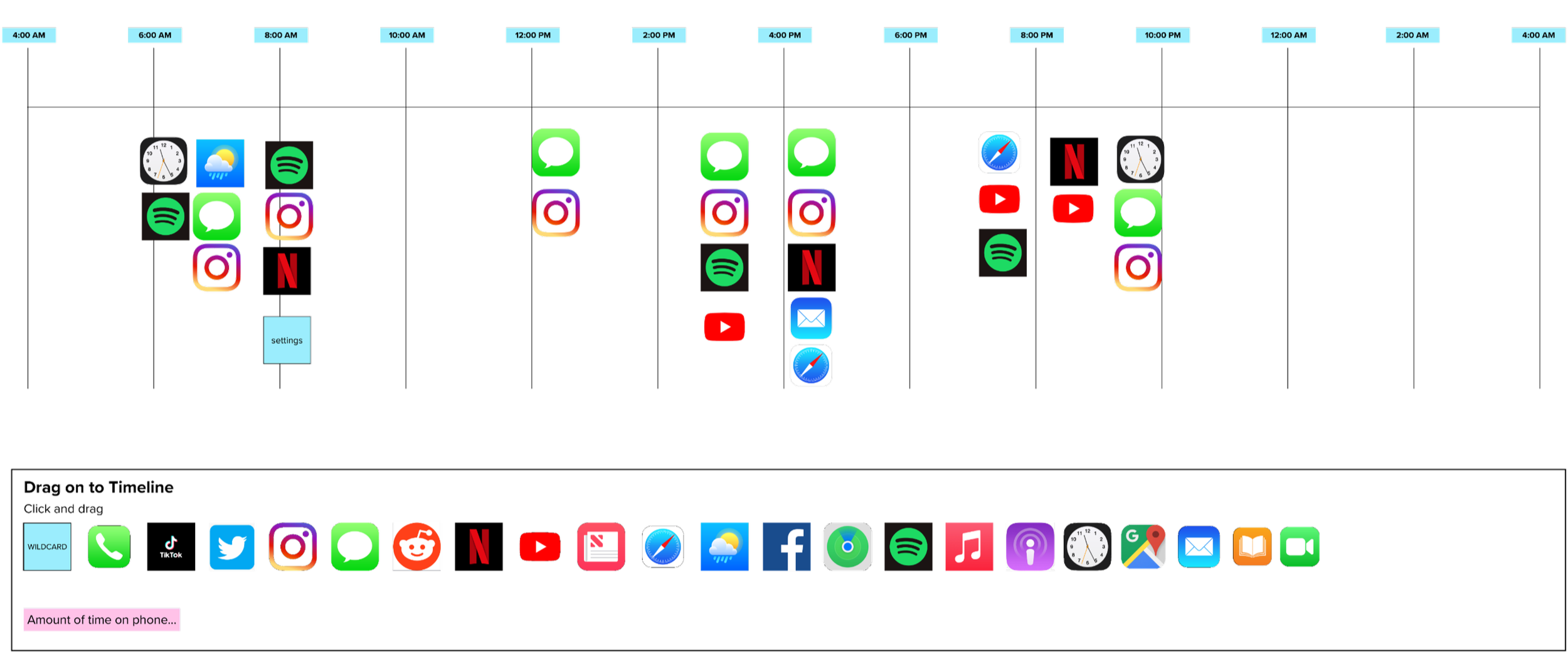
Around the same time, I began primary user interviews, interviewing people about their phone usage habits. I focused most of my research on teens and younger adults, with some outliers at higher ages. I asked them to create timelines of their day based on what apps they use when, then asked them to live react to their screen time data. I followed up with questions to get them to reflect on their phone usage, and their overarching desires (if at all) for changing their cell phone usage.
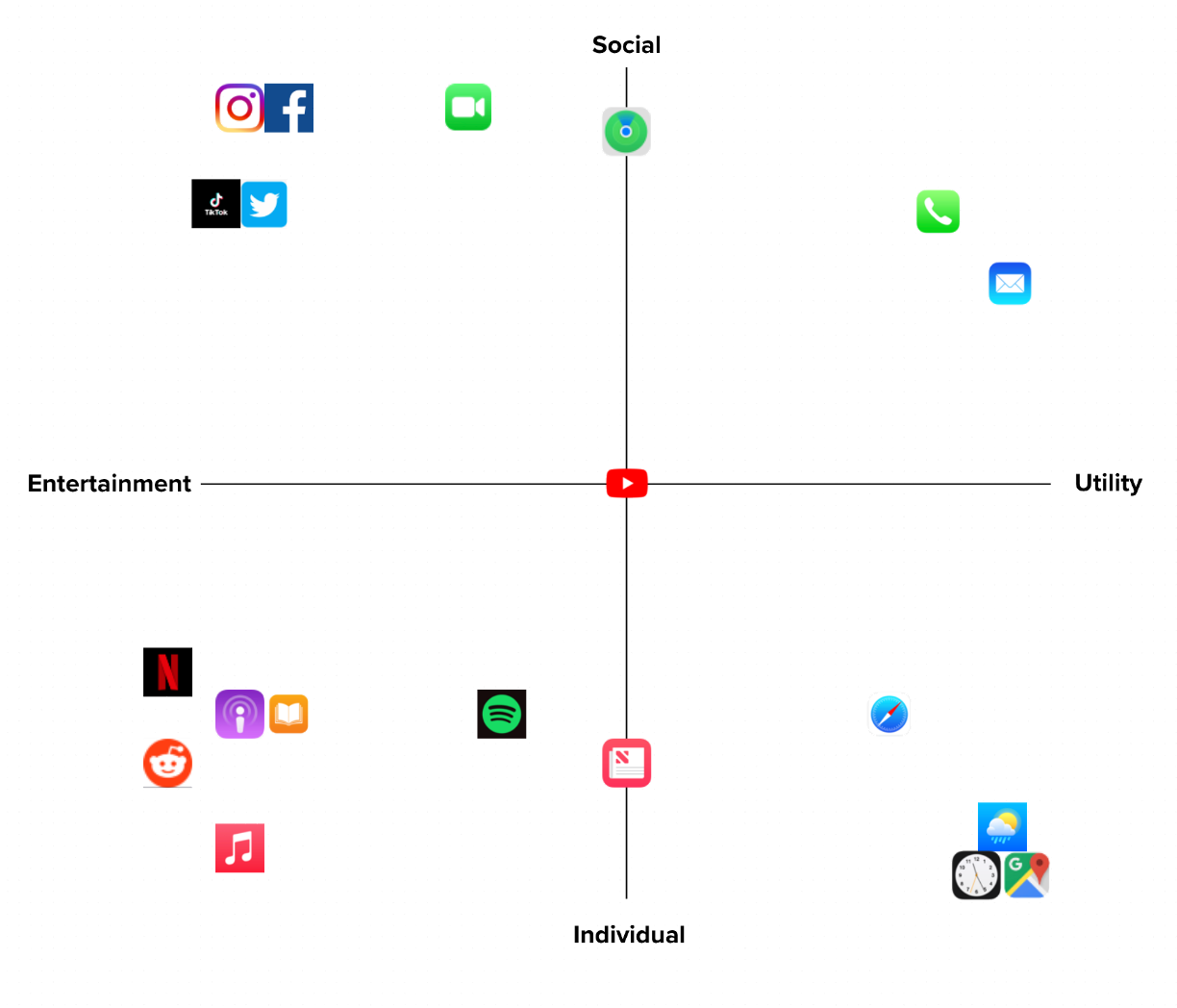
People reported using their phone much more when their mental health is suffering, highlighting the impact social media apps have on their mental health. They have a negative impact, but continue to use with use increasing as their mental health decreases. People also differentiated applications between social vs. individual, as well as utility vs. entertainment. I plotted applications along this 2x2.
Concept DevelopmentMoving from insights to brainstorming, I identified 3 key “how might we” questions to brainstorm around.
How might we address the underlying mental health issues which impact people's phone usage without making people feel guilty about their phone usage?
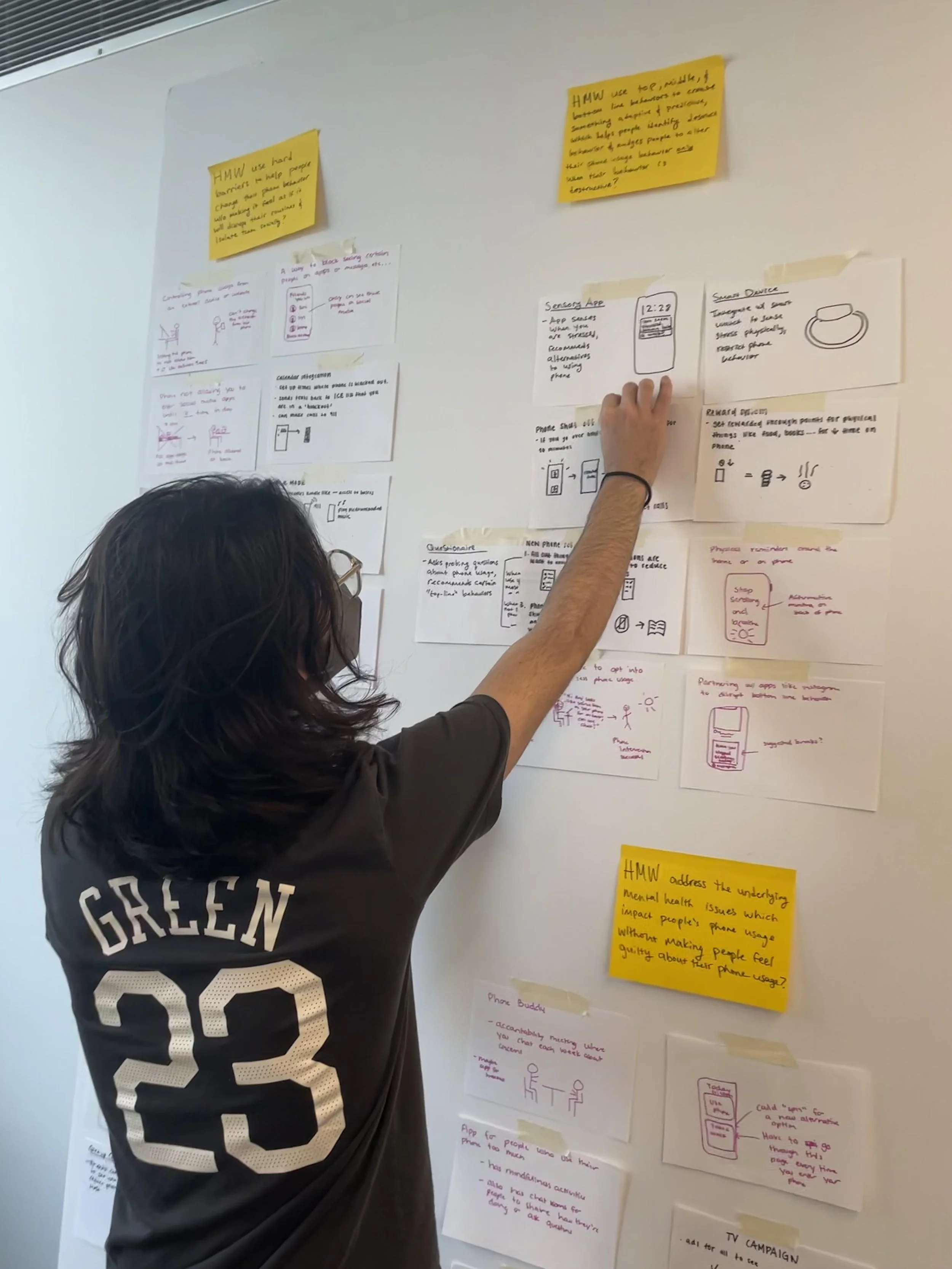
How might we use top-line, middle-line, and bottom-line behaviors to help people identify destructive behavior and to alter their phone behavior only in instances when their behavior is destructive?
How might we leverage social connection to help people change their phone behaviors while allowing them to still feel connected to the world around them?
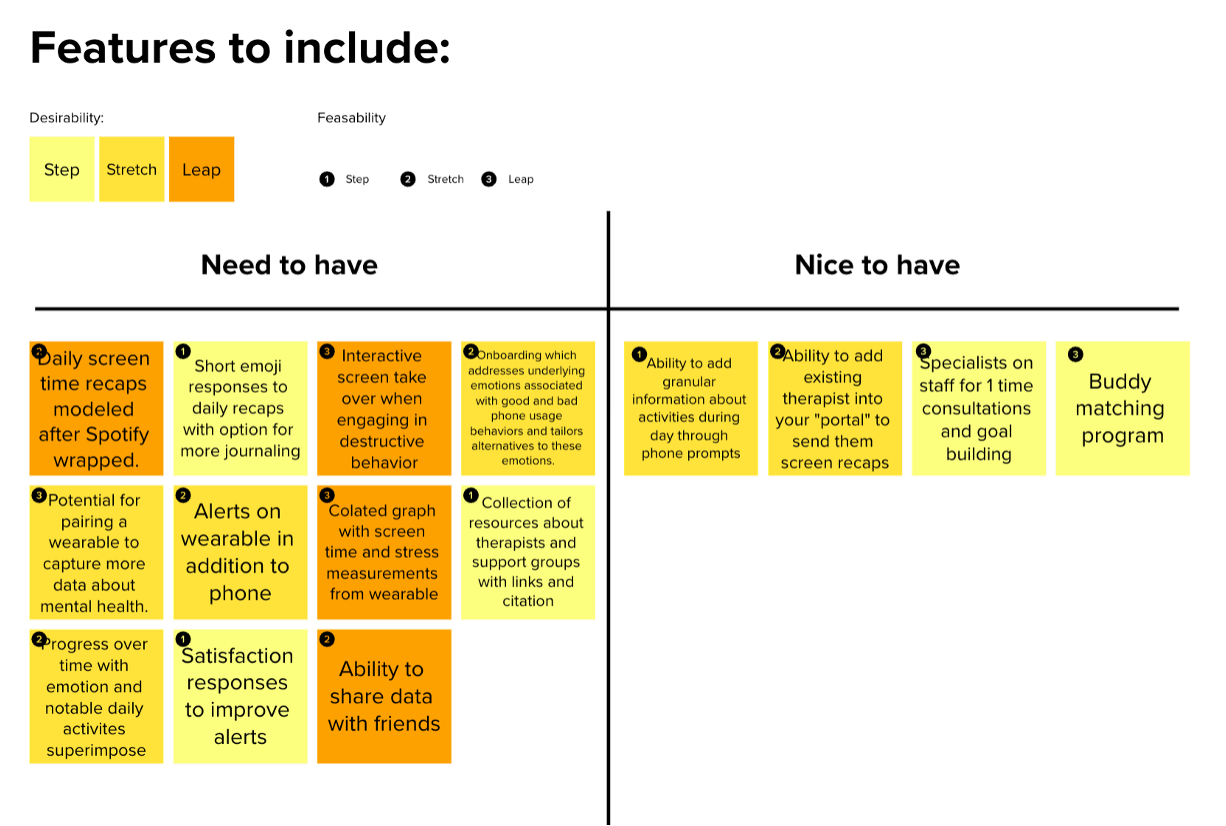
I knew my solution should be phone based, to meet users at the root of their problems I brainstormed a wide range of features (16) that could be a part of a potential application. I conducted another round of research, with cell phone users and therapists, asking people to “build” their ideal application out of these features. I asked them to rank these features from most to least important.

I ranked these features based on desirability and feasibility, and divided them into need to have and nice to have features.
PrototypingAfter ranking features, I created wireframes of specific features to start to build out what an app could look like, and solicited feedback from users on how to shape these features.
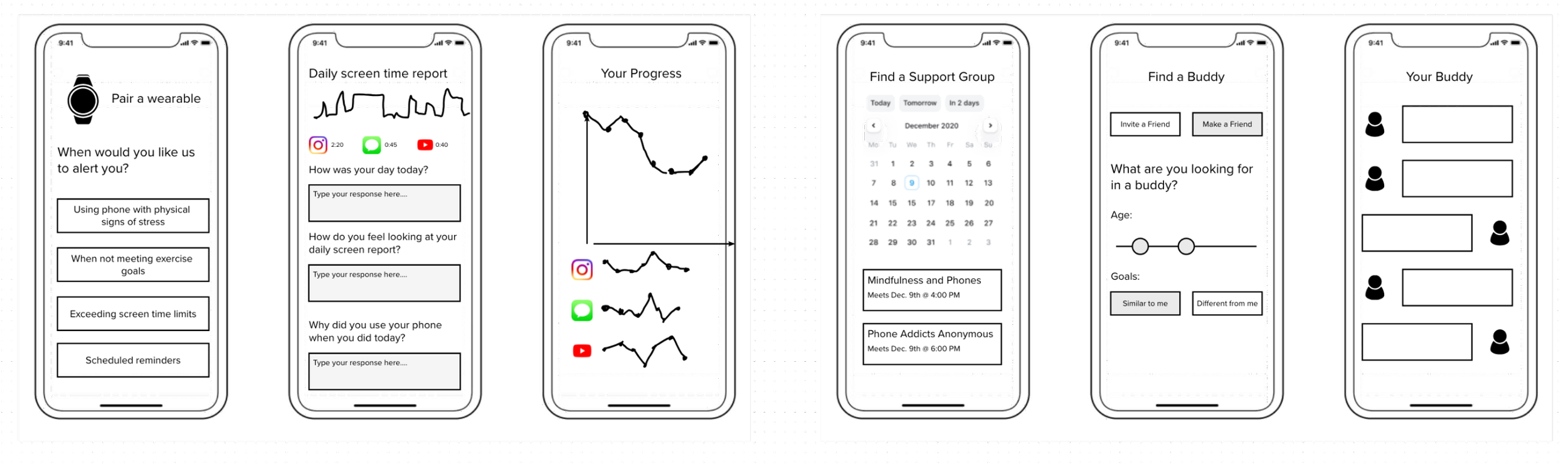
I created wireframes for these feature groups: onboarding, interruptions & alternatives, daily screen time reports, journaling, sharing data with friends, therapist integration, and wearable integration.
Based on feedback, I decided to move forward with incorporating all of those features except for therapist integration.
I also identified guiding principles for the application, to ensure trust and positive reception of the application. These included:
Celebrate success
Focus on underlying emotions
Frame the app around discovering about one’s own habits
Explain how data is being recorded and what the benefit of recording this information is
Cite sources and explain how computations or grades are being made
Be careful not to provide too many notifications
SolutionAll of these features and principles combined to create Intermission – an application which tracks peoples’ phone usage habits and provides them with interruptions, or Intermissions, when they begin engaging in specific patterns of phone usage. Intermission helps smartphone users establish healthy relationships with their phones by interrupting destructive phone usage cycles (or bottom and middle line behaviors) when they begin and recommend alternatives (or top line behaviors) instead. Intermission also unveils detailed behind the scenes phone usage patterns that users are unaware they are exhibiting to help people understand their phone usage patterns better. Intermission has 4 key components for daily use. These are:
Intermissions:
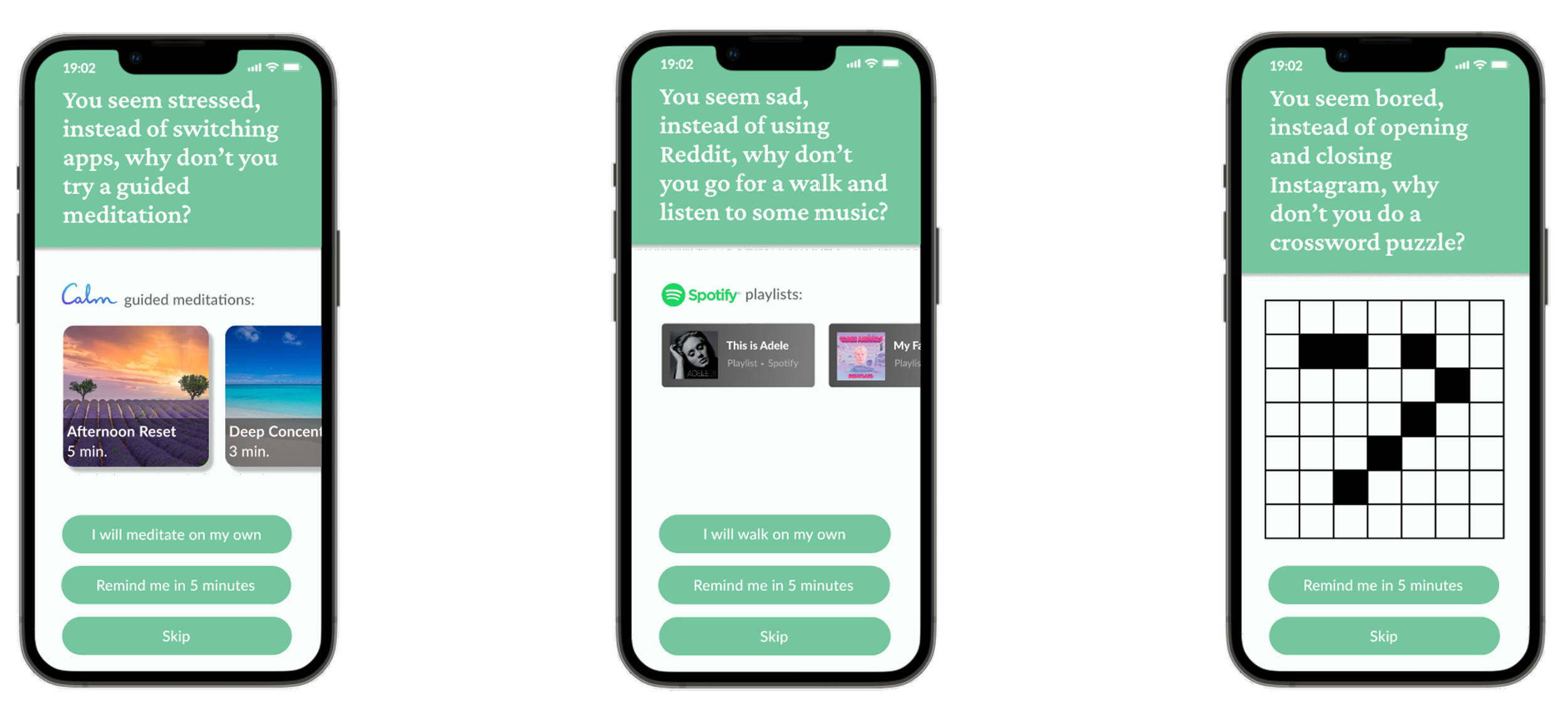
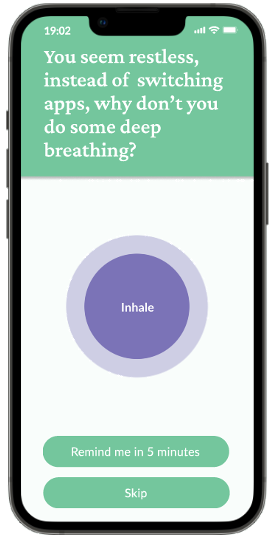
Intermissions interrupt harmful phone usage patterns as they arise, redefining the way people use their phones. These patterns might be symptoms of suffering mental health, or might be the middle or bottom line behaviors which start members down destructive cycles of cell phone usage. These could look like repeatedly opening or closing the same app, checking obsessively if someone responded to a text or viewed an Instagram story, or falling down a WebMD rabbit hole.
Intermission helps users identified what healthy alternatives to these behaviors are, and interrupts these behaviors to direct them to alternatives. These intermissions can be phone based or recommendations for actions to take off of the phone. These include a quick guided meditation, a short crossword, a walk, or calling a friend. They can be tailored to specific patterns, recommending different actions to take depending on if the user is craving social interaction, distraction, or something to calm them down.
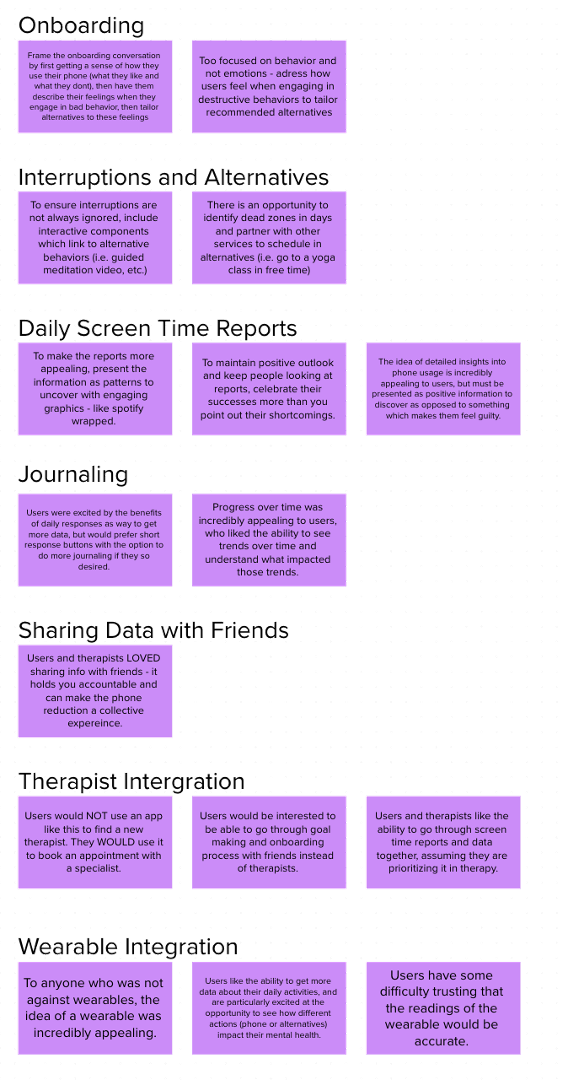
I synthesized this research into a large set of insights, and divided them into groups based on large scale trends, mental health focused, social norms, changing behavior, and outlook on phone addiction.
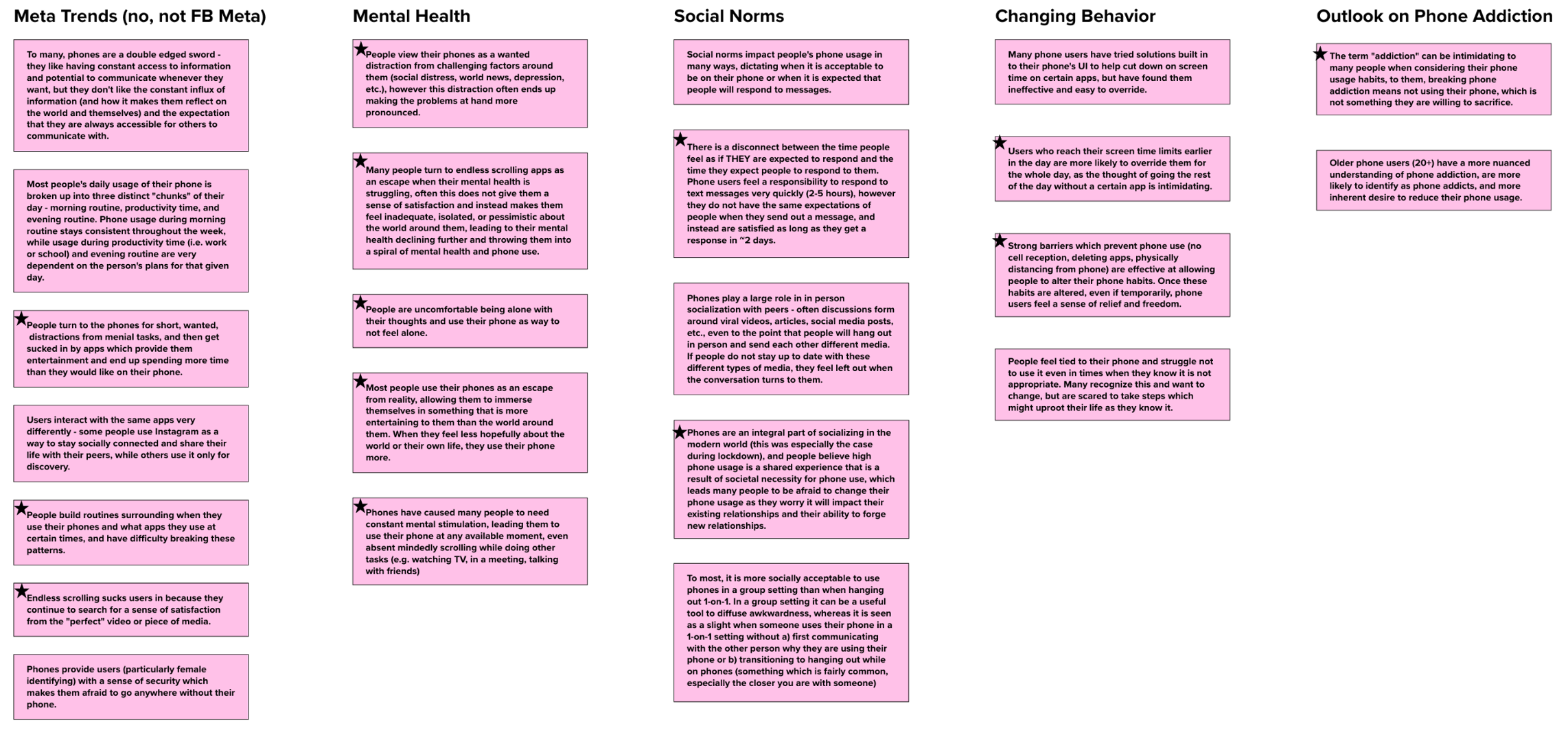
An underlying theme across these insights was the tension between peoples’ desire to change their cell phone habits and the necessity cell phones hold in their life. People view their cell phones as double edged sword – providing immense benefits which are integral to their daily lives and ability to socialize with their peers, while also posing significant downsides and impacts to their mental health.
Impact
After finishing the Intermission Figma prototype, I presented the work as my Thesis presentation to receive my master’s degree. I received resoundingly positive feedback on my solution, and was recommended to pursue building this out into a full application. Upon finishing my master’s I immediately began work at Kaiser Permanente and have not done more work on the Intermission application, but have leveraged a lot of the learnings I found at my time at KP, while leading Experience Strategy for national mental health solutions.
Daily Health Scores:
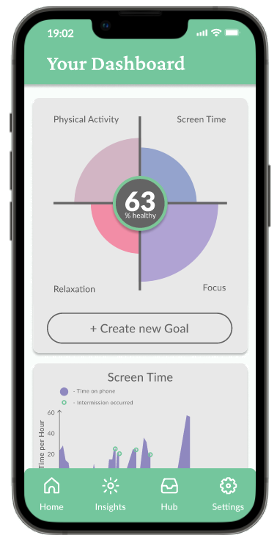
Users can also see live data on their overall mental and screen health. There are four metrics which make up a composite overall health score: Physical Activity, Screen Time, Relaxation, and Focus. These can be based on data from wearables, as well as tracking of screen time and specific apps used. This helps people track and adjust their usage throughout the day to meet their goals.
Metrics are can be personalized to each users’ preferences and goals, and can learn and improve over time based on users’ journal responses to be as accurate a representation of their daily progress as possible.
Recap:
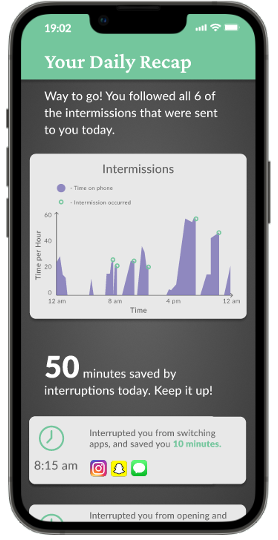
The final core functionality is a recap, set to the users desired frequency (daily or weekly) which summarizes their usage trends over time, in an engaging way which promotes self discovery and unearths new insights. It allows users to journal about their day, so the application can compare their usage to specific moods or events during the day to provide more detailed insights in the future.
The recap was inspired by the Spotify annual recap, which presents data as a self discovery process that people look forward to. The Intermission recap taps into curiosity to establish experience as a self-learning experience, celebrates success to reinforce a positive mindset, and uses familiar metrics to make progress tangible. It brings focus to subconscious behaviors users are not aware they exhibit and helps them understand relationship between her phone usage and various experiences from her day.
Onboarding:
The onboarding experience for Intermission allows users to input their behavior change goals, and allows them to determine their path to recovery. The onboarding experience helps support in building goals, with sorted behaviors to pick which users want to change or eliminate. The onboarding process will ask questions which help users reflect on what underlying emotions drive each of these different behaviors, and once identified, Intermission generates options for alternative behaviors for the app to set as intermissions.
Users can customize their intermission settings based on their goals and the results of their onboarding.