
Creating a comprehensive product strategy to improve aging adults’ interactions with iRobot products.
Design Strategy, Experience Design, Service DesignSeptember 2021 - December 2021
My Responsibilities: Project management, insight development, framework creation, concept system development, UX screen creation.
Deliverables: Concept system, UX screens, slide deck presented to iRobot.


Overview
As part of a design strategy studio class, iRobot partnered with my graduate program to receive strategy consulting advice on their Roomba and Braava product lines, looking to investigate opportunities in home health. This project gave me an opportunity to refine my design strategy skills and familiarity with a more front end design process. I worked with a team of 4 other designers to create iRobot Connect.
Opportunity
iRobot as they began exploring the space of home health. To narrow down this prompt, chose to focus on aging gracefully within the home. Through user research and careful development of a business model and product positioning, we created a concept system which we presented to iRobot. We called this system iRobot Connect.
For aging adults who need more interaction to help them complete tasks around the home, iRobot Connect is an active partner that works together with them to ensure cleaning is completed in a way that meets their expectations while preserving their sense of purpose.
Process

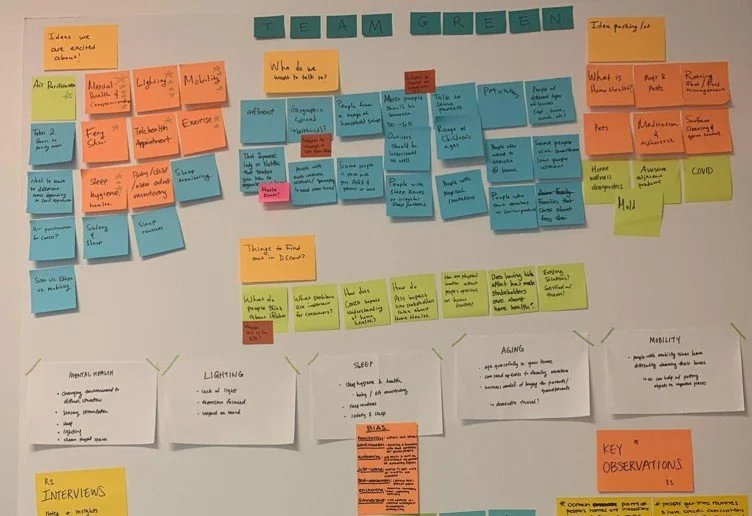
Problem Space ExplorationWe started by brainstorming different interpretations of what “home health” could mean, to identify a focus area to design within.
We focused on areas where iRobot had a “right to win.” We wanted to build on iRobot’s reputation in the cleaning space. After careful consideration of iRobot’s existing portfolio of products, and learning of iRobot’s poor market penetration for aging adults, we chose to focus on aging.
Our goal became: Helping older adults age gracefully in their homes
Primary ResearchAfter focusing on aging gracefully, we spoke with aging adults as well as their adult children/caregivers, to get a better sense of their changing needs as they age. We unpacked their relationships with technology, cleaning, and the changes in the parent/child dynamic.
We synthesized this research and identified four key insights:
Need for Interaction: Without human interactions, aging adults lose motivation to complete asks they know are essential for their mental and physical health.
Trust & Acceptance: In order to accept help for tasks around the home, many need to be able to trust that the help they receive will be done to their long-held standards.
Sense of Purpose: As some adults age, they become less active, which leads them to rely on daily chores as a source of purpose in their lives, making it difficult for them to give up ownership of these tasks.
Changing Care Dynamics: As parents age, adult children transition into caregivers for their parents. In order to delay this transition, children want to provide resources to help their parents complete tasks in the home, but need a sense of assurance that these tasks are being completed safely.
🗣️
"I live alone but I like to leave the door to my apartment open just so I can feel connected to other people... it gives me a feeling of not being completely cut off from the world." - Larry, 75
🗣️
"A cleaning product would have to clean to my mom's standards. She likes it her way, or no way..." - Debra, 54
🗣️
"Unless you’re there with parents, they don’t tell you what’s wrong. They become passive — if you don’t ask the question you don’t even find out“ - Lauren, 63
🗣️
"My parents try to do a small load of laundry a day just to keep them busy." - Debra, 54
🗣️ "I live alone but I like to leave the door to my apartment open just so I can feel connected to other people... it gives me a feeling of not being completely cut off from the world." - Larry, 75 🗣️ "A cleaning product would have to clean to my mom's standards. She likes it her way, or no way..." - Debra, 54 🗣️ "Unless you’re there with parents, they don’t tell you what’s wrong. They become passive — if you don’t ask the question you don’t even find out“ - Lauren, 63 🗣️ "My parents try to do a small load of laundry a day just to keep them busy." - Debra, 54
We began brainstorming different frameworks to use to communicate these learnings to our clients. Each member of our group solo-stormed a couple different frameworks, and then we worked together to synthesize and refine. We created two frameworks, one speaking to the importance of interaction for aging adults and one which communicates the way iRobot can capitalize on the changing care dynamic between aging adults and their adult children.
IdeationAfter fully understanding the needs of aging adults, their adult children, and iRobot, we began ideating different features for our solution.
To begin this ideation, we took each of our four key insights and framed them as “how might we” questions:
Need for Interaction → How might we leverage human or synthesized interactions to help older adults complete essential tasks?
Trust & Acceptance → How might we make our products customizable to aging adults’ particular needs?
Sense of Purpose → How might we help aging adults with chores while preserving their sense of purpose?
Changing Care Dynamics → How might we provide children with assurance of their parents’ wellbeing without undermining their parents’ sense of independence?
We then brainstormed different solutions to these 4 “how might we” questions, and sorted through individual features brainstormed. Afterwards, we grouped these features together to create different groups of concepts. From there, we went through each feature and qualified it as a “step,” “stretch,” or “leap” for both feasibility as well as desirability, looking at desirability through the lens of aging adults and their adult children).
We identified interaction as a key driver for older adults’ ability to clean. We plotted elderly assistive and cleaning devices across the spectrum of interactive vs. passive. The most interactive products cleaning products on the market were iRobot devices, which aging adults had difficulties interacting with. We learned that the smart technology easiest for aging adults to use was based in voice control – we identified a gap for verbally interactive, assistive cleaning products which we wanted our concept to explore.
Framework CreationThe first shows the relationship between interaction and physical health, mental health and motivation, all factors which impact aging adults’ ability to clean their home. Currently iRobot only focuses on the actual acts of cleaning, but we saw an opportunity for iRobot to consider all of these factors to create a more impactful product.
The next framework depicts the relationship between aging adults, their adult children, and iRobot. We identified an opportunity to market our solution to the adult children of aging adults in hopes of having them purchase our solution for their parents. This allows iRobot to leverage the existing relationships and trust built with adult children to gain the trust of aging adults. It also positions our product as a intergenerational partner within the home.
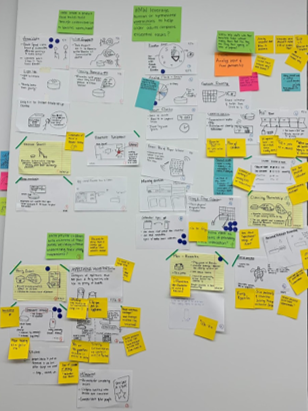
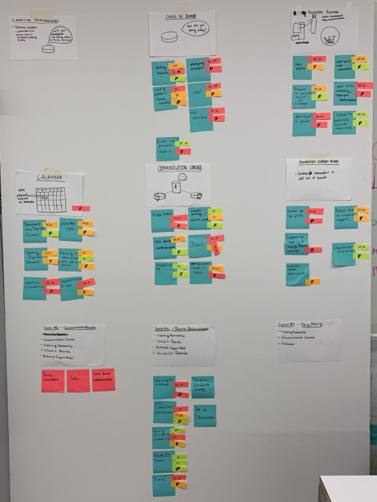
Creating Concept SystemAfter assessing the feasibility and desirability of features, we assembled them into a concept system, with a strategic blend of “steps,” “stretches,” and “leaps” to ensure it is disruptive enough to warrant investment from iRobot but not too forward thinking that the investment required would preclude iRobot from pursuing it.
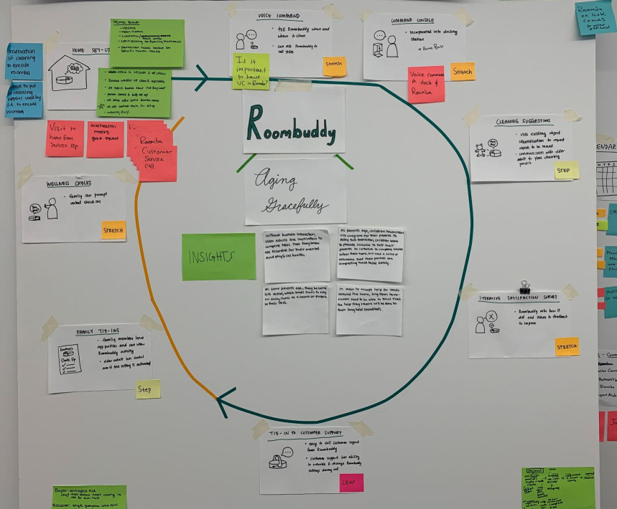
After creating our concept system, we created a business canvas model to understand exactly how our system will work on a financial level for iRobot.
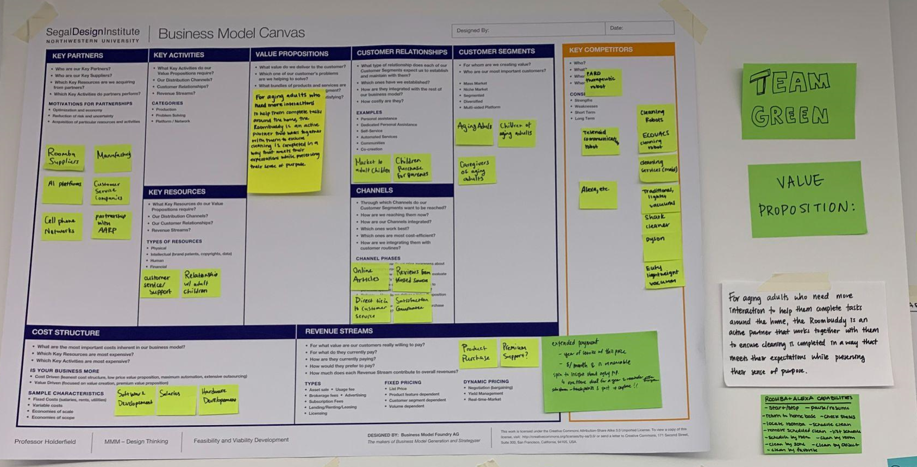
After playing around with a few names, we named our solution iRobot Connect. iRobot Connect is a collection of features which can be added into any iRobot product, like a Roomba or Braava. iRobot can sell these robots enabled with iRobot Connect at a higher price point than the entry level version of the same products.
Robot Connect is broken up into 2 distinct groups of features separated by 2 different pay structures:
iRobot Connect - Baseline Features
Voice command in Robots
Robot seeks feedback
Tie-in to family members’ iRobot app
Family outside the home can check in on their loved ones with Robots
iRobot Assist - Premium Subscription Service
In-home set up with an iRobot Assistant
Reliable customer support accessible 24/7
Direct calling to iRobot Assist through Bluetooth connection to Robots
iRobot Assist has remote access to Robot and its settings
The key features which make up iRobot Connect and iRobot Assist can be seen below:

Voice Command
Voice command will be incorporated into iRobot devices to ensure aging adults can interact even when they have a range of physical or technical limitations.

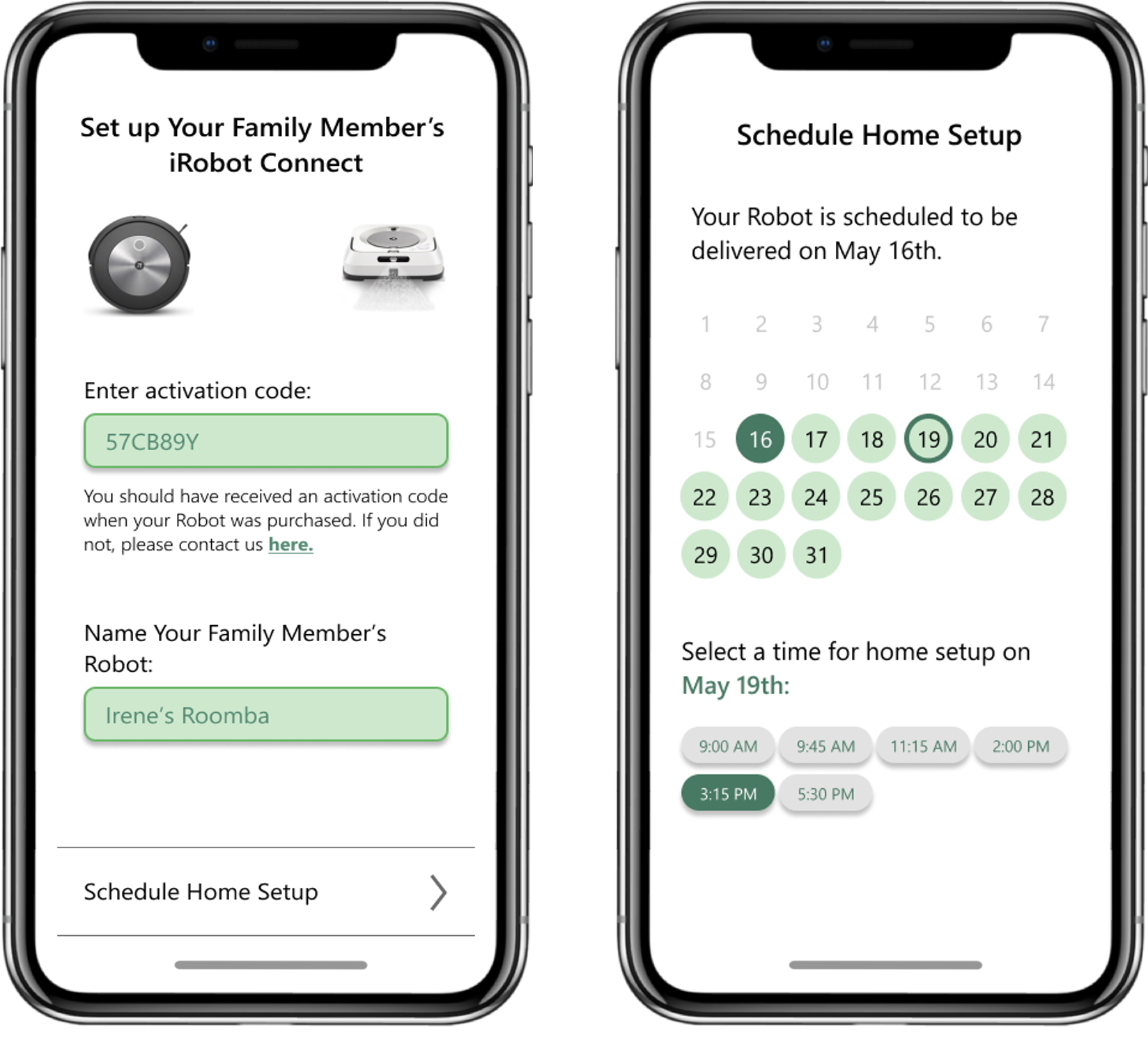
In-Home Setup
Children of aging adults will have the ability to schedule 1:1 in-home setups through iRobot Assist, to help:
Teach how to use their new product
Input desired cleaning settings for each room
Pair the device with their children's application
Guide on how to use bluetooth calling to get help whenever they want.
Bluetooth Calling to iRobot Assist
Device will detect when their are lapses in communication when trying to change device settings, and offer to connect with iRobot Assist (support) directly.
Wellness Checks
Children or caregivers can initiate wellness checks on aging adults if they are worried about them. They can send them a message, and have the device go looking around the home to find their parent and make sure they are healthy.
Cleaning Suggestions
As the device cleans the home, it will ask the owner to straighten up rooms so it can clean to the best of its ability. This preserves their of purpose by keeping them busy within their home, and promotes their trust of the robots by helping them understand why cleaning is not always completed as specified.
Satisfaction Survey
After completing essential cleaning tasks, the device will check with the owner to ensure that the cleaning was completed to their satisfaction. It will ask if there are any improvements to make, and change settings for future cleans.


Presenting to ClientsAs we prepared our presentation to our clients at iRobot, we knew we need to present our system in a creative way to ensure they would understand all the touch points we had designed. To do so, we storyboarded the story of Irene, an aging adult and Aiden, her adult son. A teammate of mine drew the storyboard while I created the UX flows.

Impact
After presenting our work to our clients at iRobot, we received resounding positive feedback, both from our client and from our professor.
This project was significant for my individual growth, having given me the chance to act on my project manger skills and grow them in a consulting and strategy setting. This project was also particularly exciting as it was the first time I was able to design work in person since the start of my master’s program – we got messy with sticky notes and project boards, and were able to be as visual as we wanted with our frameworks.